Condo vs Townhouse: What Salt Lake County Buyers Should Compare
Condo vs townhouse is a key decision for Salt Lake County buyers weighing lower-maintenance options. While both can offer affordable entry points and shared amenities, they differ in ownership structure, maintenance responsibility, insurance, and financing. Understanding these differences helps you choose the property type that fits your budget, lifestyle, and willingness to handle upkeep.
Quick Answer
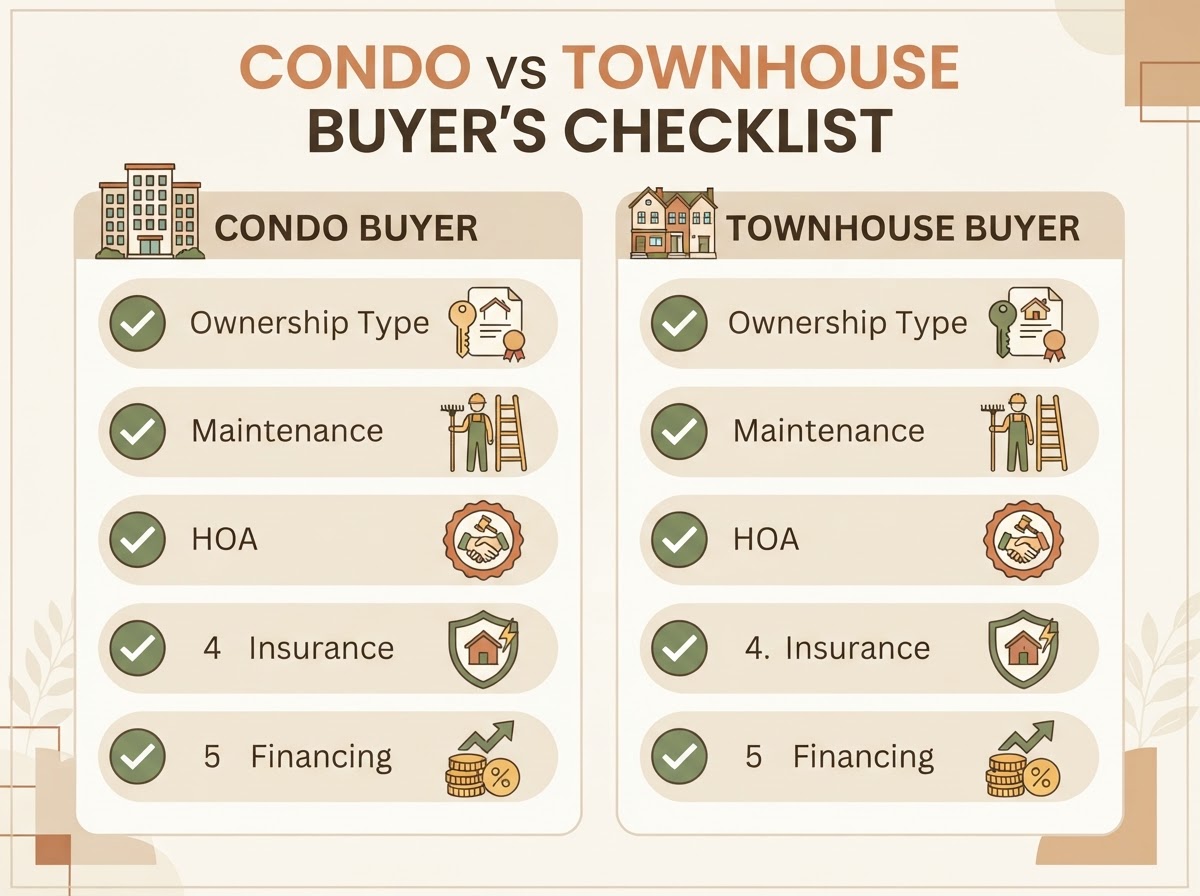
The main difference is ownership. A condo means you own the interior of your unit, while the HOA owns and maintains the exterior and common areas. A townhouse typically means you own the unit and the land it sits on, and you may maintain the exterior. Both usually have HOA fees, but the scope of what the HOA covers differs. Compare ownership, maintenance, insurance, assessments, and financing before choosing.
Key Takeaways
- Ownership differs: Condo owners own the interior; townhouse owners often own the unit and land.
- Maintenance responsibility: Condo HOAs typically handle exterior; townhouse owners may handle exterior maintenance.
- HOA scope varies: Both have HOAs, but what the dues cover differs — review the documents.
- Insurance differs: Condos need a walls-in policy (HO-6); townhouses may need a full homeowner's policy, depending on the HOA master policy.
- Assessments can be costly: Special assessments for major repairs can be charged to owners in both types.
- Financing can differ: Some condos are harder to finance if the project is not approved by the lender.

Ownership Structure
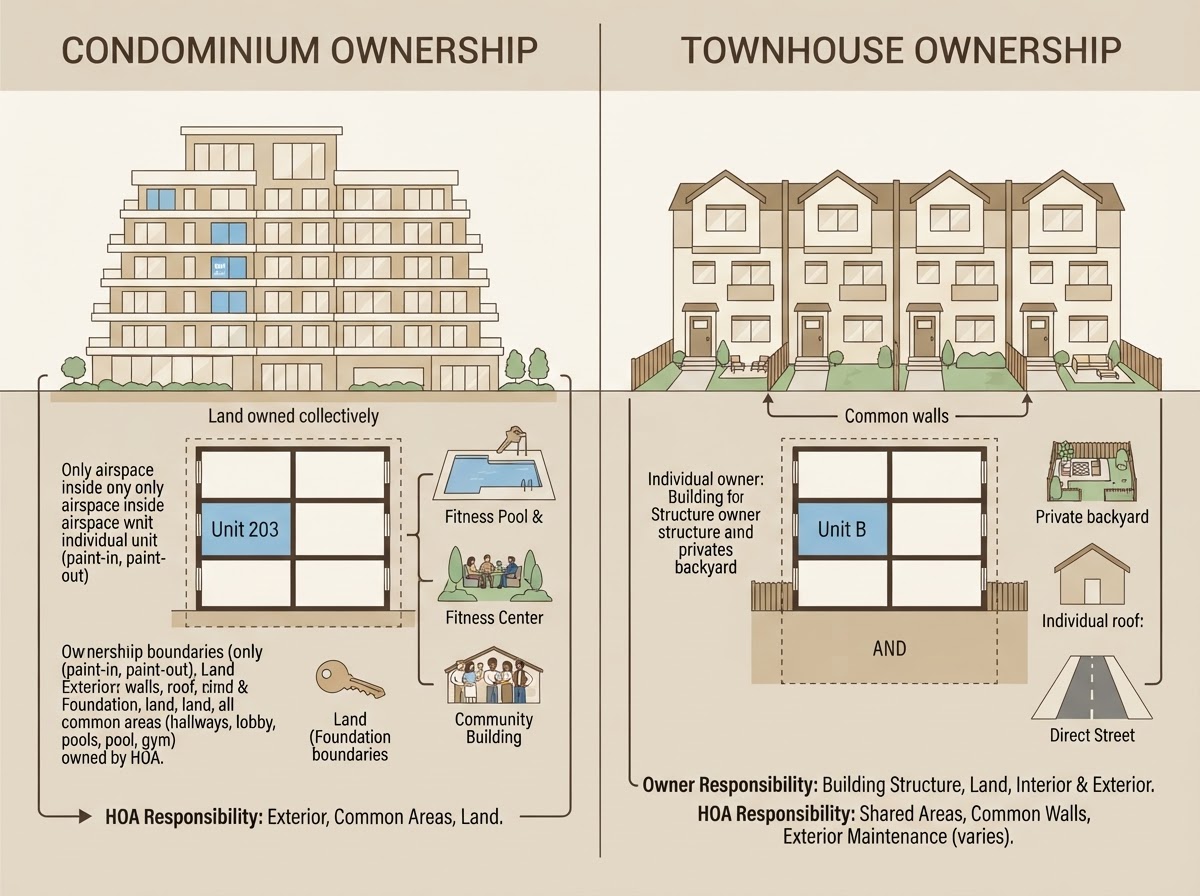
With a condo, you own the interior of your unit, while the exterior, structure, and common areas are owned and maintained by the HOA. With a townhouse, you typically own the unit and the land it sits on, and you may be responsible for exterior maintenance. The exact ownership structure is defined in the HOA documents — always review them before buying.
Condo vs Townhouse Comparison
| Factor | Condo | Townhouse |
|---|---|---|
| Ownership | Interior of unit | Unit and often the land |
| Exterior maintenance | HOA handles | Owner may handle (varies by HOA) |
| HOA fees | Typically higher (covers more) | Typically lower (covers less) |
| Insurance | Walls-in (HO-6) policy | Full homeowner's policy (usually) |
| Privacy | Shared walls, possibly above/below | Shared walls, no units above/below |
General comparison — specifics vary by property and HOA. Always review the HOA documents for the exact ownership and maintenance responsibilities.
Maintenance Responsibility
In a condo, the HOA typically handles exterior maintenance — roofing, siding, landscaping, and common areas. You maintain the interior. In a townhouse, you may be responsible for exterior maintenance — roof, siding, yard — depending on the HOA. This affects both your monthly costs and your time commitment. If you prefer low maintenance, a condo may suit you; if you want control over the exterior, a townhouse may be a better fit.
HOA Fees and What They Cover
Both condos and townhouses typically have HOA fees, but the scope differs. Condo HOA fees are usually higher because they cover exterior maintenance, insurance on the structure, and common amenities. Townhouse HOA fees are often lower because they cover fewer items. Review the HOA documents to understand what dues cover, the reserve fund, and any pending special assessments. See our HOA fees guide for what to review.
Insurance Differences
Condo owners typically need a walls-in (HO-6) policy that covers the interior and personal property, while the HOA's master policy covers the building. Townhouse owners usually need a full homeowner's policy, though this depends on what the HOA master policy covers. Confirm with the HOA and your insurance agent what the master policy covers so you buy the right individual policy. Insurance costs differ between the two — factor them into your monthly budget.
Financing Considerations
Financing a condo can be more complex than a townhouse. Some lenders require the condo project to be approved — if the project is not approved, financing may be harder or unavailable, especially for FHA or VA loans. Townhouses are often financed more like single-family homes. If you are considering a condo, ask your lender whether the project is approved and what loan types are available. See our pre approval guide for financing preparation.
Frequently Asked Questions
What is the main difference between a condo and a townhouse?
Ownership. A condo owner owns the interior of the unit; the HOA owns and maintains the exterior and common areas. A townhouse owner typically owns the unit and the land, and may maintain the exterior. Review the HOA documents for specifics.
Which has higher HOA fees, a condo or a townhouse?
Condo HOA fees are typically higher because they cover exterior maintenance, structural insurance, and common amenities. Townhouse HOA fees are often lower because they cover fewer items. Always review the HOA documents for the specific property.
Do I need different insurance for a condo vs townhouse?
Often yes. Condo owners typically need a walls-in (HO-6) policy, while the HOA's master policy covers the building. Townhouse owners usually need a full homeowner's policy. Confirm what the master policy covers before buying individual insurance.
Are condos harder to finance than townhouses?
They can be. Some lenders require the condo project to be approved. If it is not approved, financing may be harder, especially for FHA or VA loans. Townhouses are often financed more like single-family homes. Ask your lender about project approval.
Who handles maintenance in a condo vs townhouse?
In a condo, the HOA typically handles exterior maintenance. In a townhouse, the owner may handle exterior maintenance, depending on the HOA. This affects your monthly costs and time commitment.
Can Scott Allen's buyer credit apply to a condo or townhouse purchase?
Eligible buyers may receive a credit of up to $3,000 toward eligible closing costs, prepaid expenses, or interest-rate buydowns. Terms and eligibility apply, including lender approval and transaction requirements. The credit applies to eligible closing costs for either property type. Ask Scott how it fits your purchase.
Comparing Condos and Townhouses?
Scott Allen helps Salt Lake County buyers compare property types, HOA costs, and total ownership expenses. Eligible buyers may receive a credit of up to $3,000 toward eligible closing costs, prepaid expenses, or interest-rate buydowns. Terms and eligibility apply, including lender approval and transaction requirements.
Understand the upfront budget before you choose the home.
Get a Salt Lake County Buyer Consultation or call (801) 424-9283.